
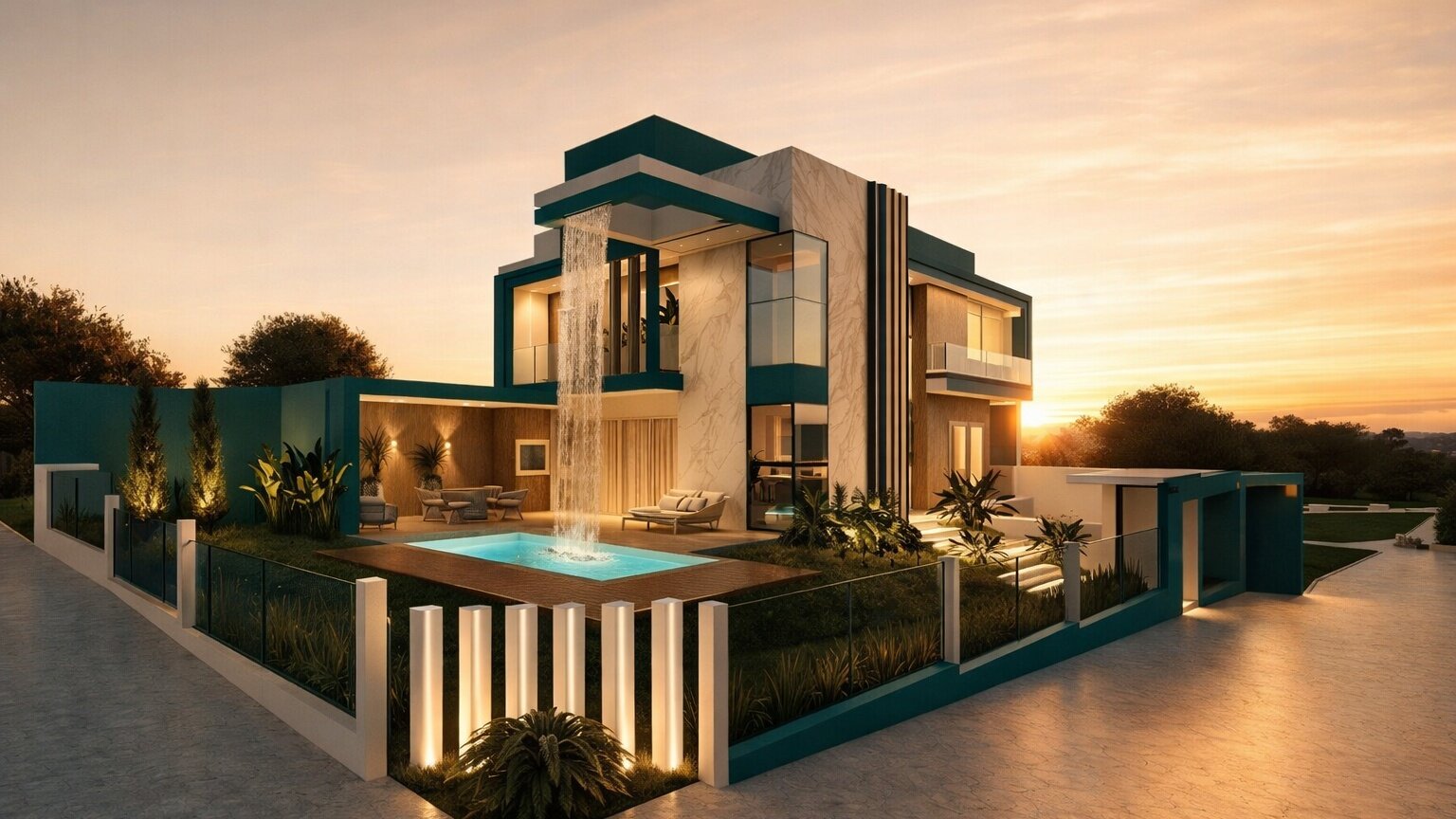
Most people who dream of building a custom home picture the finished product. What they never picture is the twelve months of decisions, constraints, and creative problem-solving that happen before a single wall goes up. That gap is exactly why I invited Mark Nichols MNichols Design founder, California and Washington licensed architect, and LEED accredited professional, onto LUXEtalk.
With over 15 years of experience in residential and mixed-use architecture, Mark has trained at firms like KAA Design and LARGE Architecture, and been featured in LA Weekly and Destination LA. He brings deep expertise in the full concept to completion architecture process – and in this episode, he shares exactly how it works.
Here is what this article covers:
- The real phases of the architecture process, from first meeting to breaking ground
- An honest look at timelines – and why the optimistic version rarely holds
- How a 14-foot basement error turned into a better-designed home
- What is actually holding up the Palisades rebuilds
- Where sustainable luxury home design is heading next
Watch the whole conversation here:
What Mark Nichols MNichols Design Gets Right About the Architecture Process
The most common misconception clients bring to a first meeting is that hiring an architect means getting the plans. As Mark explained in the podcast episode, the drawings are just one instrument of service. The real work is guiding the client through every decision, constraint, and coordination challenge from start to finish as a residential architect in Los Angeles.
Here are the foundational principles of his process:
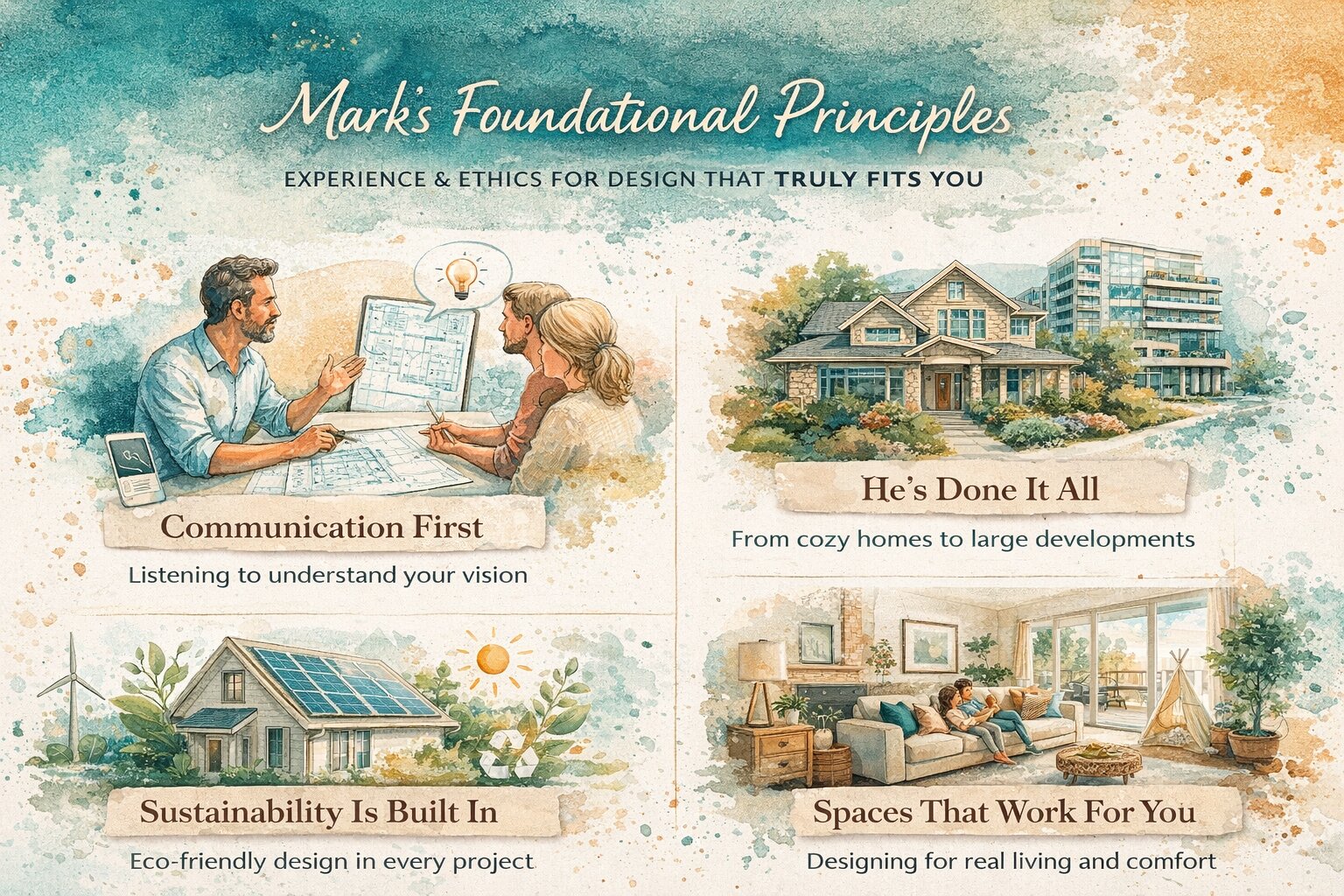
Communication First
Mark will be the first to tell you – it all starts with listening. He takes communication with his clients seriously, and that “get it right” mentality drives everything he does. You’re not just hiring someone to draw up plans; you’re working with someone who genuinely wants to understand what you need.
He’s Done It All
Whether you’re a first-time homeowner or a large-scale developer, Mark has worked with clients like you before. His background at KAA Design and LARGE Architecture means he’s navigated everything from intimate custom homes to big mixed-use developments, so whatever your project looks like, he knows how to adapt.
Sustainability Is Already Built In
You don’t have to ask for sustainable design because it’s already part of how Mark thinks. His training at the University of Oregon made sustainability a core part of his worldview, so it naturally shows up in his work without you having to push for it.
Spaces That Actually Work for You
Mark designs with your life in mind, not just the aesthetics. His goal is to create spaces that make room for the moments that matter, the kind of design that you feel, not just see.
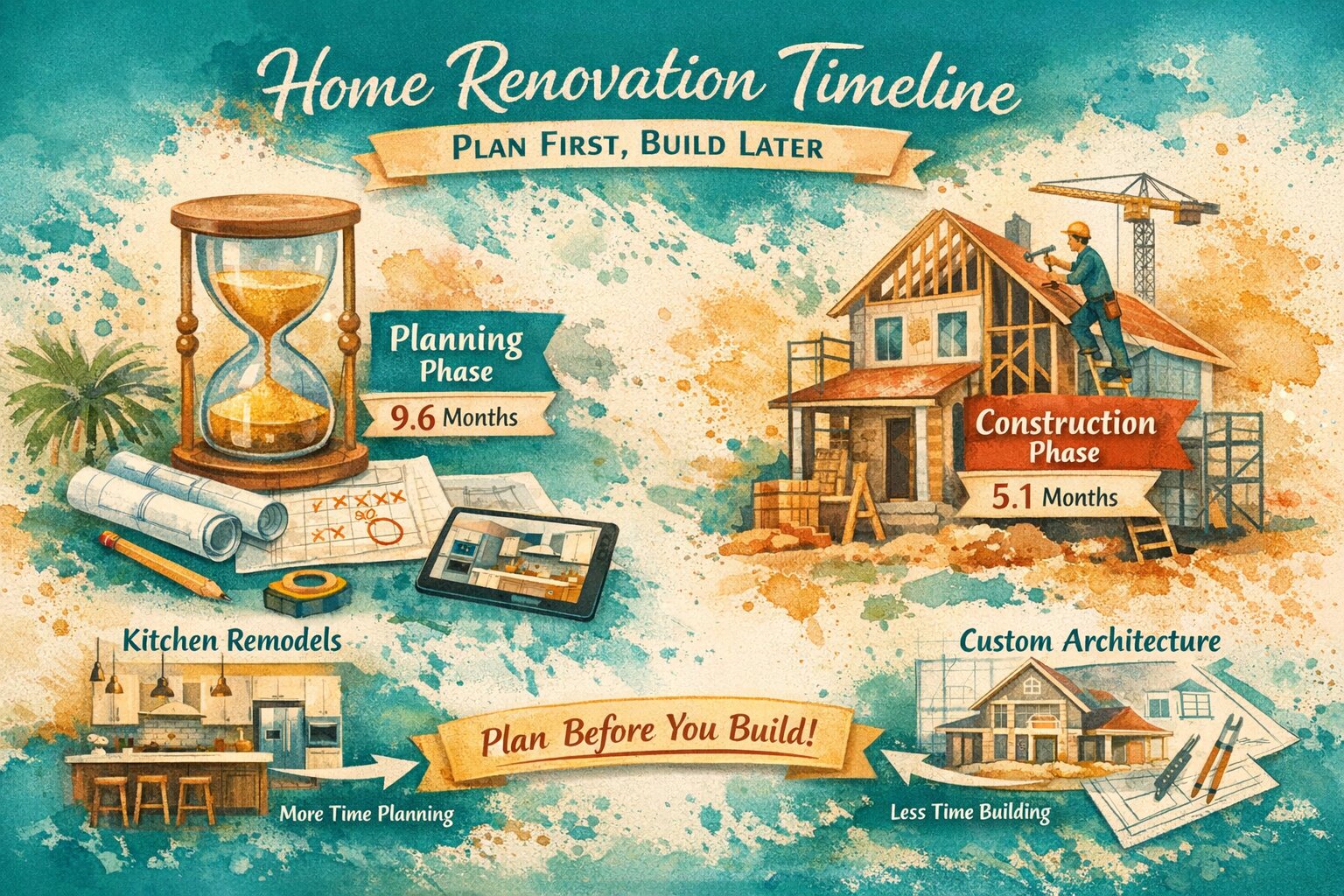
According to a 2024 Houzz study, homeowners spent nearly twice as much time planning their renovations as actually building them – with kitchen projects averaging 9.6 months of planning versus 5.1 months of construction. That ratio holds in custom architecture too. As Mark emphasized in the episode, skipping the groundwork means chasing your tail in schematic design later.
The Real Timeline – And Why You Should Not Count On the Optimistic Version
One of the most useful things Mark shared was an honest breakdown of what timelines look like – and then an equally honest walk-through of why the ideal version rarely plays out.
“You could technically, from start of hiring an architect to permit in hand and start of construction, be at about eight months for a mid-size new construction home. Now that I’ve said all that – don’t count on that at all. Budget eleven to twelve months. That’s conservative, that’s reasonable, and that’s a lot safer.” – Mark Nichols, Founder, MNichols Design
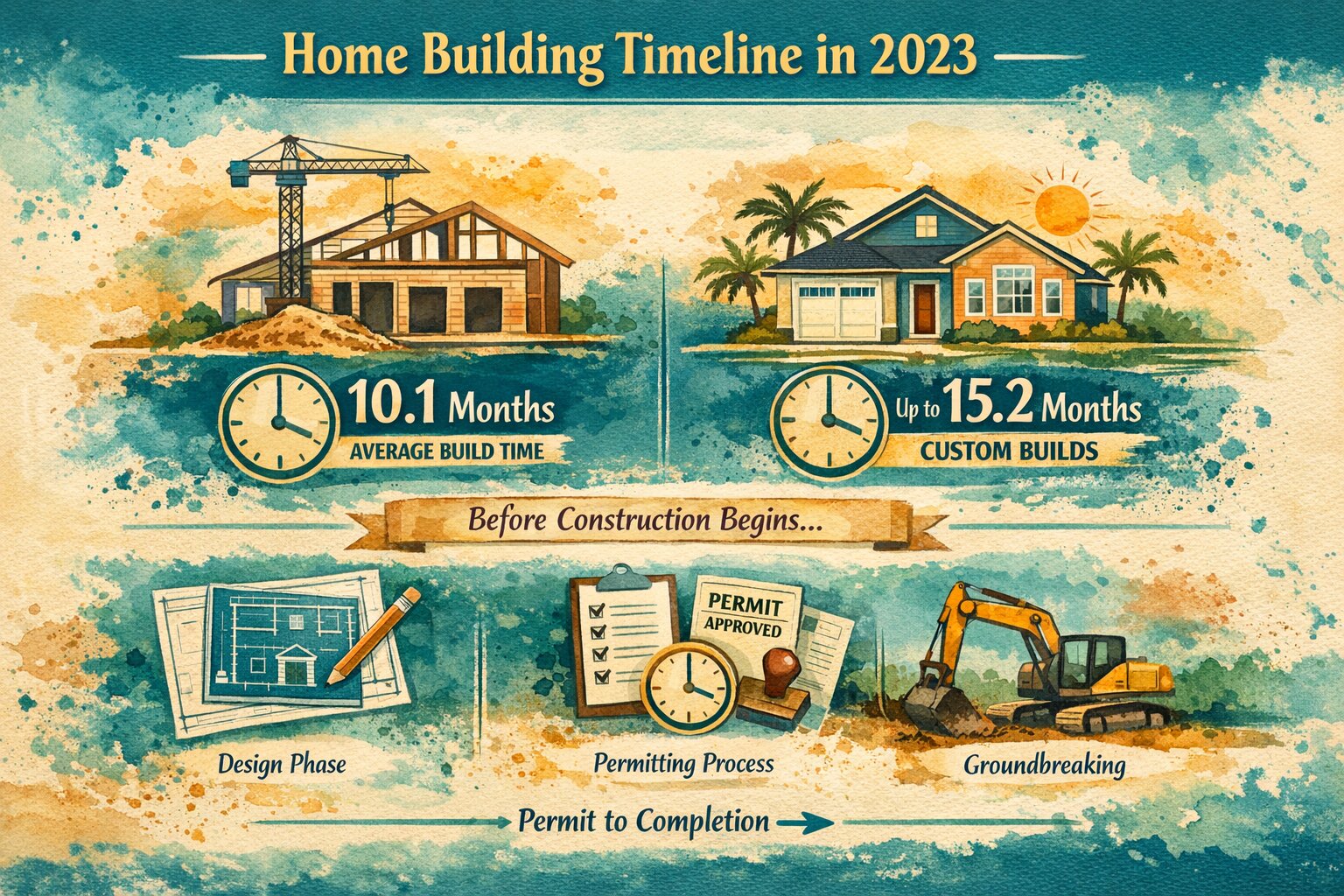
The U.S. Census Bureau (via NAHB) found that the average time to build a single-family home in 2023 was 10.1 months – with custom builds stretching as long as 15.2 months from permit to completion. And that is just construction – not the design and permitting months that come before ground break.
| Phase | Best Case | Realistic |
| Schematic design | 6–8 weeks | 6–10 weeks |
| Design dev + consultants | 6–8 weeks | 2–3 months |
| Plan check / permitting | 3–4 months | 5–6+ months |
| Total before ground break | ~8 months | 11–12 months |
Even after plans are finalized, delays can stack up. According to the Associated Builders and Contractors (2023), the average U.S. contractor carries roughly 9.2 months of construction backlog. Your project may be queued for months before work even begins.
When a 14-Foot Basement Error Became a Better Home
This is the story from our conversation that best illustrates what separates a good architect from a great one.
Mark is currently working on a Palisades fire rebuild architect project. The clients had originally gone with a design-build company offering pre-designed models at a reduced fee. They got through the entire permitting process, got a permit ready to pull – and then looked at the drawings and realized they were not happy. No renderings, no material specifications, flat line drawings only. They let go of the design-build team, brought on a new GC, and that GC referred Mark.
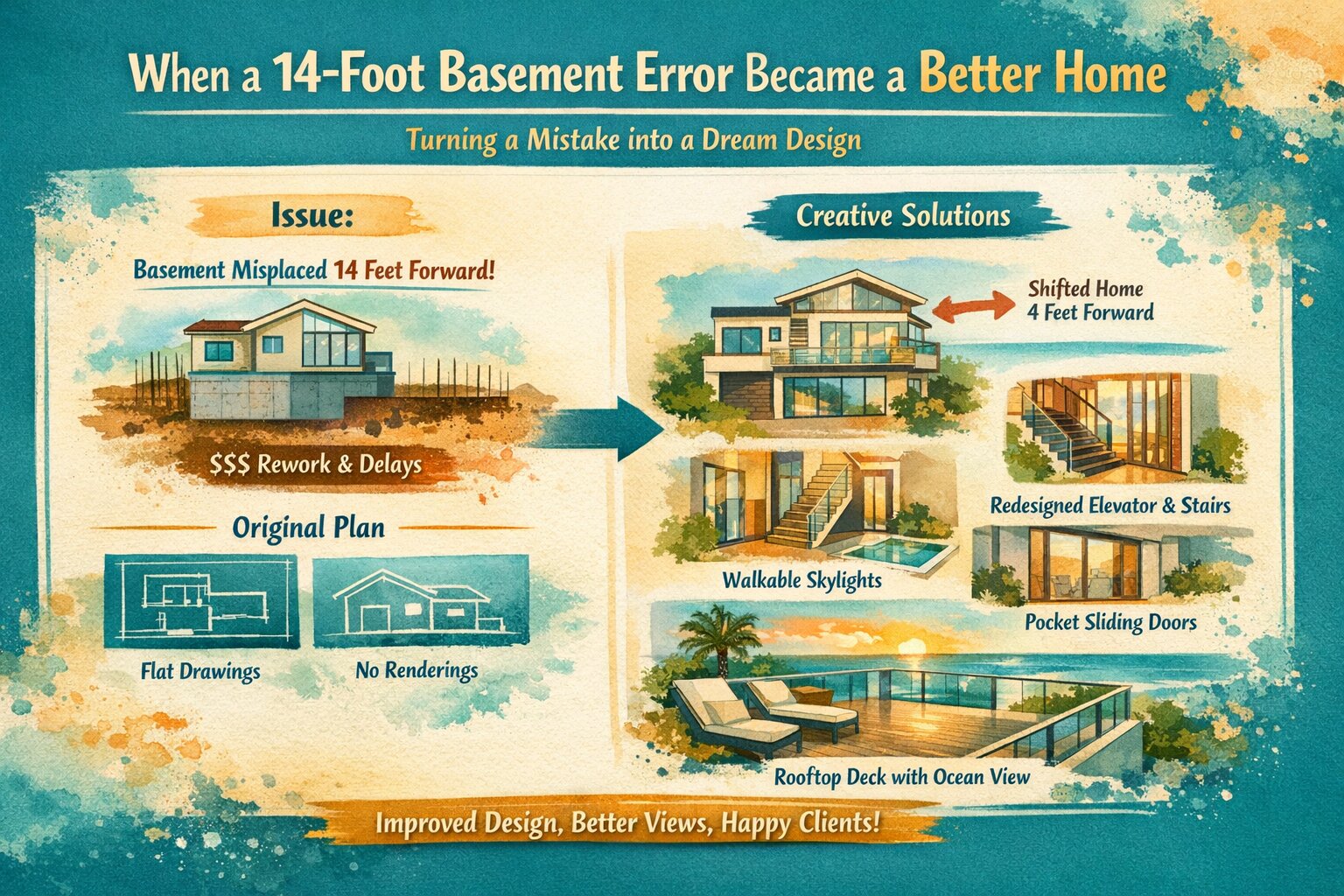
By the time Mark was brought in, construction had already started under the prior drawings. A drafting error had placed the basement 14 feet farther forward than it should have been. The formwork and rebar for a subterranean basement were already set. Mark estimated over $100,000 in rework and six additional weeks of delay if the conventional fix was applied.
“Some architects might just say, tough luck, move the basement. But that is not it. You want to be a good project teammate. The GC is on your team – architect and GC are not adversarial. And you are there to be the client’s agent. This client wants to be back in their home. Encouraging the solution that is likely going to go to lawsuit and extend the timeline – you are not fulfilling your role.” – Mark Nichols, Founder, MNichols Design
Instead of assigning blame, Mark found a design solution to resolve the 14-foot basement discrepancy while avoiding a lawsuit or costly rework.
- He moved the above-grade floors four feet closer to the front property line, reducing the remaining discrepancy to 10 feet.
- He completely relocated the elevator and shifted the stairs, which removed the elevator penthouse that had been blocking the view from the rooftop deck.
- By repositioning the powder room closer to the living area, he opened up a better, more private entrance into the office.
- To compensate for a slightly reduced foyer footprint, he introduced oversized pocket sliding doors, walkable skylights to pull light down the stairwell, and a stair with no riser to allow natural light to reach the basement.
The result provided more net improvements than the original design, including gaining four feet of space in the backyard, which had previously been cramped
What Is Actually Holding Up the Palisades Rebuilds
The common narrative blames permit processing speed. But as a Palisades fire rebuild architect working directly in this space, Mark sees a different picture.
LADBS has streamlined its process considerably. Homeowners can rebuild what was there plus 10% in footprint and height, with full basements approved freely as long as they do not expand the footprint beyond that threshold.
For a 2,000-square-foot home, that could mean a fully built-out basement – wine room, home theater, gym – at no footprint cost.
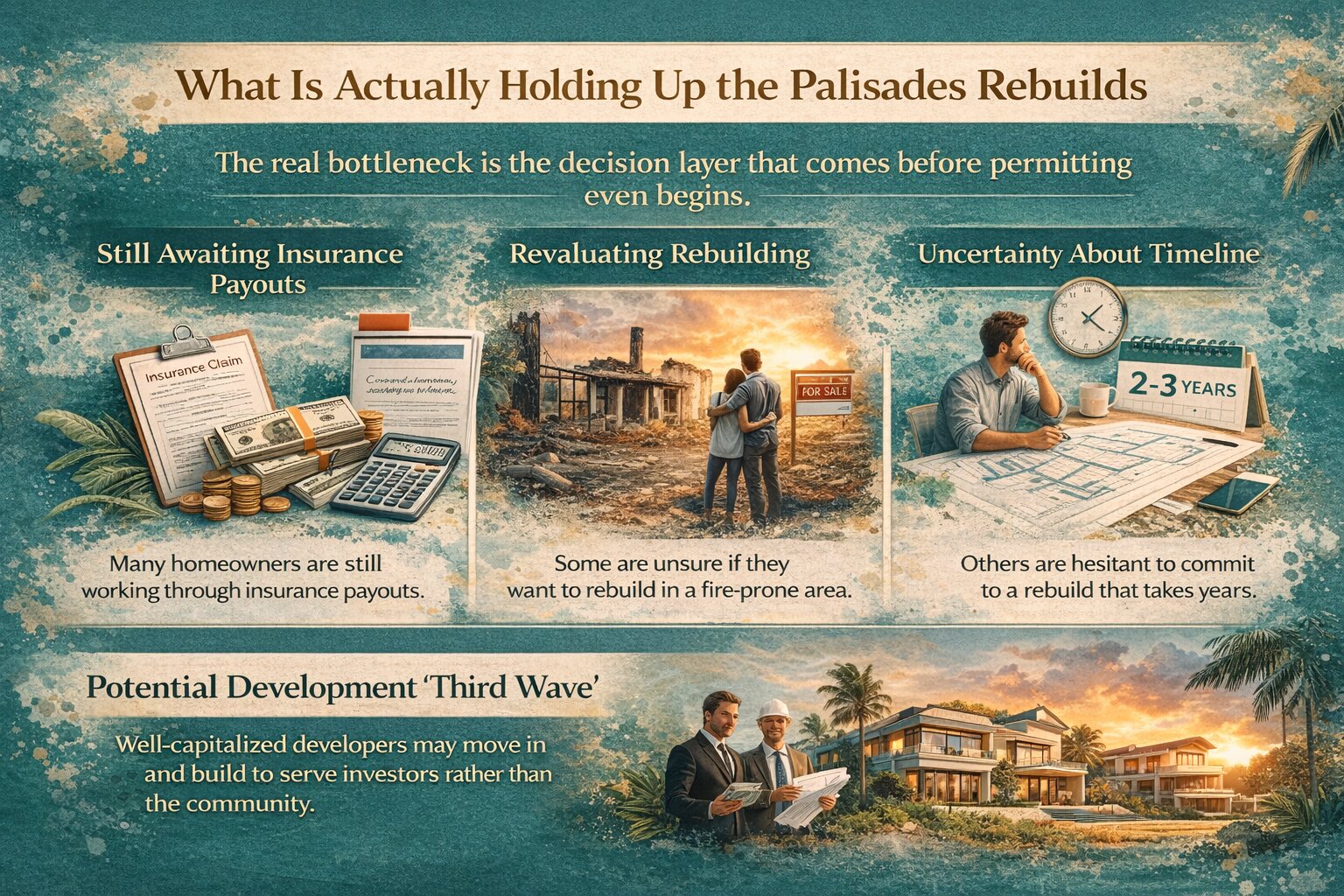
The real bottleneck is the decision layer that comes before permitting even begins.
- Many homeowners are still working through insurance payouts.
- Some are evaluating whether to rebuild in a fire-prone area at all.
- Others are not ready to commit to a two-to-three year rebuild timeline.
Mark also flagged a concern he calls the “third wave.”
This is the point when homeowners who have been undecided finally choose to either rebuild or sell their properties
. He worries that opportunistic, well-capitalized developers and “investment-style companies” will “swoop up” these properties to build what he describes as “passable luxury housing”. Whether this plays out depends on whether policy restrictions are put in place to prevent these companies from “sweeping up” the local real estate
Sustainable Luxury Home Design Is Becoming Invisible – and Better for It
In the late 1990s and early 2000s, sustainable features in luxury homes were displayed. Solar panels on the roof. Rainwater cisterns expressed as architectural elements. High performance was luxury, and the message was clear: look how consciously we built this.
What Mark is excited about in sustainable luxury home design now is the opposite.
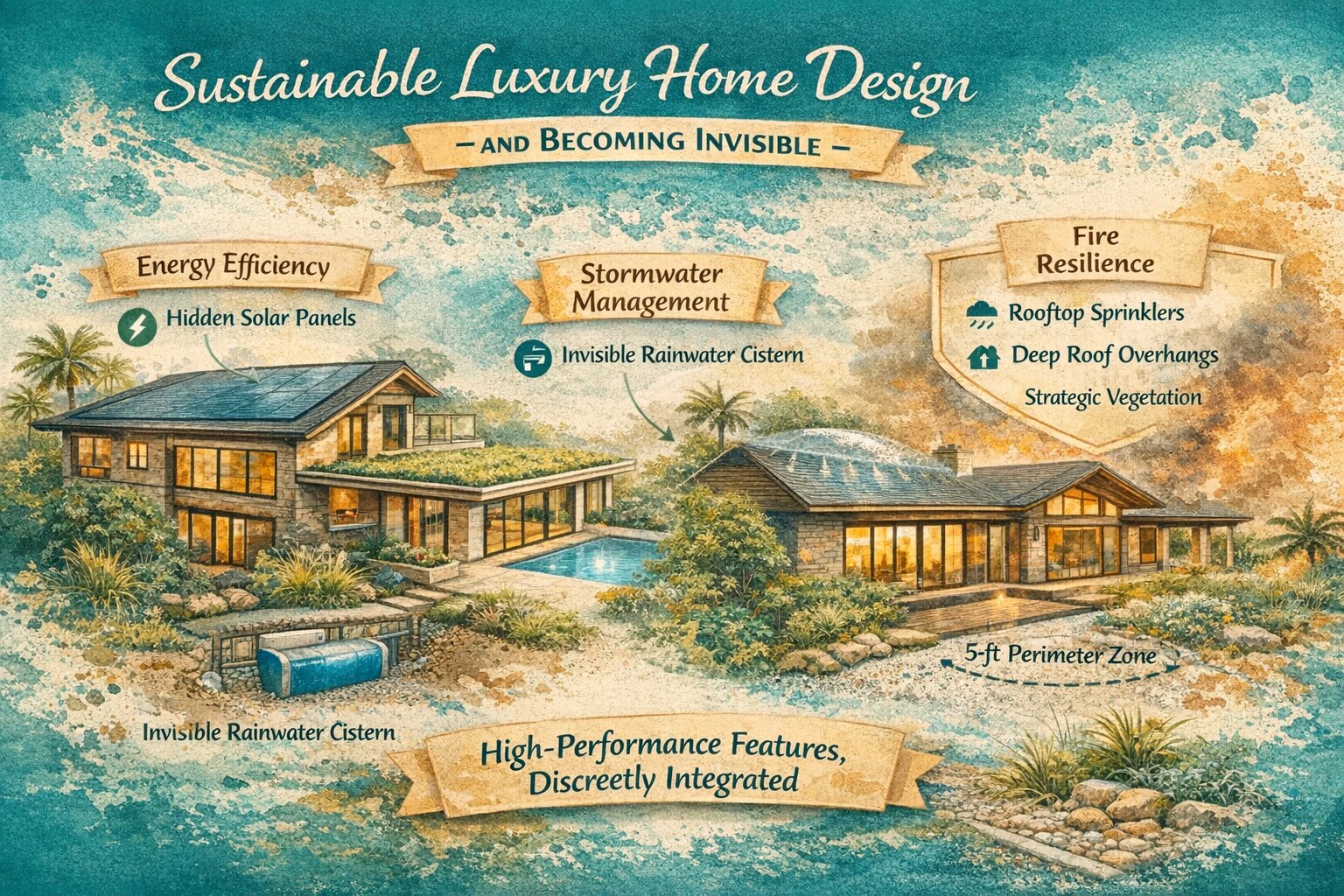
Today’s luxury client still values sustainability – energy efficiency, stormwater management, fire resilience – but wants it integrated invisibly. Solar panels that disappear into the roofline. A green roof that blurs into a living interior-exterior connection. Fire-resilient construction that does not look like a bunker.
“Great design – you do not even notice it. That is what I am working toward now – sustainable systems that are just inherent to the architecture, that improve it, that you would never know were there unless someone told you.” – Mark Nichols, Founder, MNichols Design
This applies especially to fire resilience. The standard fire-ready home diagram is technically defensible but livable for no one: boxy structure, tiny windows, gravel yard.
Mark is working through what a high-end, fire-resilient home actually looks like – deep roof overhangs, rooftop sprinklers that activate in the five-foot perimeter zone, strategic vegetation placement instead of bare lots. The challenge and the opportunity are the same: make safety feel like luxury custom home architecture.
The Takeaway
The design phase in luxury custom home architecture is not overhead. It is leverage. What you invest there compounds through every phase that follows. For anyone considering a custom build, a new construction vs. resale decision, or a fire rebuild, the first step is choosing an architect who listens, front-loads the process, and solves problems creatively instead of defensively. Start by understanding where you stand – get a home valuation, browse current listings and available properties, and understand how school zones shape neighborhood value before committing to a direction.
Whether you are working with buyers, managing properties, or supporting sellers in Whatcom County, Washington – this conversation is a reminder that the depth of the design process is what determines the outcome. And as Mark Nichols MNichols Design shows, the best outcomes often come from the hardest constraints.
Keep the Conversation Going
If you want to work with an architect who listens deeply, designs beautifully, and solves problems with creativity, follow Mark Nichols:
If something in this episode made you think, do not let it stop here. Follow LUXEtalk and stay part of the conversation.
Follow Lisa Berg:
Apply to Be a Guest on LUXEtalk
If you serve the real estate industry – through architecture, staffing, lending, brokerage, technology, or advisory – and help clients build smarter, not just bigger, let’s spotlight your insights.