
Can you create a home you love without overspending on features that will not add lasting value? On this episode of LUXEtalk, I talked with Julie Mariotti of EV Custom Homes, a custom builder, designer, and high-end REALTOR® in the Washington, D.C., area. She shared where to invest, where to save, how she uses ChatGPT in design, and when a renovation is not worth the cost.
Quick takeaway: Put your money into a few wow features, save on the rest, and be honest about whether a renovation will pay off.
From International Politics to Custom Home Building
Julie wanted to design as a child. Her parents steered her toward something more academic, so her degrees are in international politics. She worked in government affairs, took time off to raise her children, and later joined a friend in real estate. That led her into construction and design.
In 2014, she and her partners started EV Custom Homes. They build in McLean and North Vienna in Northern Virginia. At the time of our talk, they had finished 18 homes and had three under construction. Julie says she felt immediately competent, and she is on site every day, in work boots and jeans.
Multiple Income Streams in Custom Home Building in Northern Virginia
Julie believes entrepreneurs should have several streams of income. Hers fit together:
- Real estate sales, which she has done for about 16 years.
- Lot acquisition, since the team looks for good lots every day.
- Spec homes, financed with a small group of investors.
- Construction and sales, all in-house.
- Interior design, through EV Interiors, which helps clients source and furnish.
She says every lot has a personality. In her area, many neighborhoods have older tear-down houses, so you must build with the neighborhood in mind. Her real estate background helps her judge what will sell and at what price point. Even 20 minutes from the White House, she sometimes deals with septic systems and wells.
Functional Home Design: Plan for How You Will Live
Julie Mariotti, co-founder of EV Custom Homes, was influenced by her years in Paris. She believes your surroundings affect your mood, and she wants homes that feel calm and inviting. She also designs for everyday life.
“I try to make sure that there’s space for everything, like there’s plenty of storage and closets, and a utility closet, a place for a broom or a Dyson or something like that, and think it all through. A big laundry, a big linen closet, things that are practical. You want to be able to live in your house comfortably and not feel like you’re stuffed and you have no place to put anything. […] It’s all part of the plan: how am I going to live in that house, and how are my clients going to live in that house?”
I agree, and I added that women often notice these details that others might miss. This is functional home design at its simplest.
ChatGPT for Interior Design: From Sketch to Cabinet
Julie is in the fun part of three projects, designing the interiors. She calls AI a fantastic tool for designers. Here is her process:
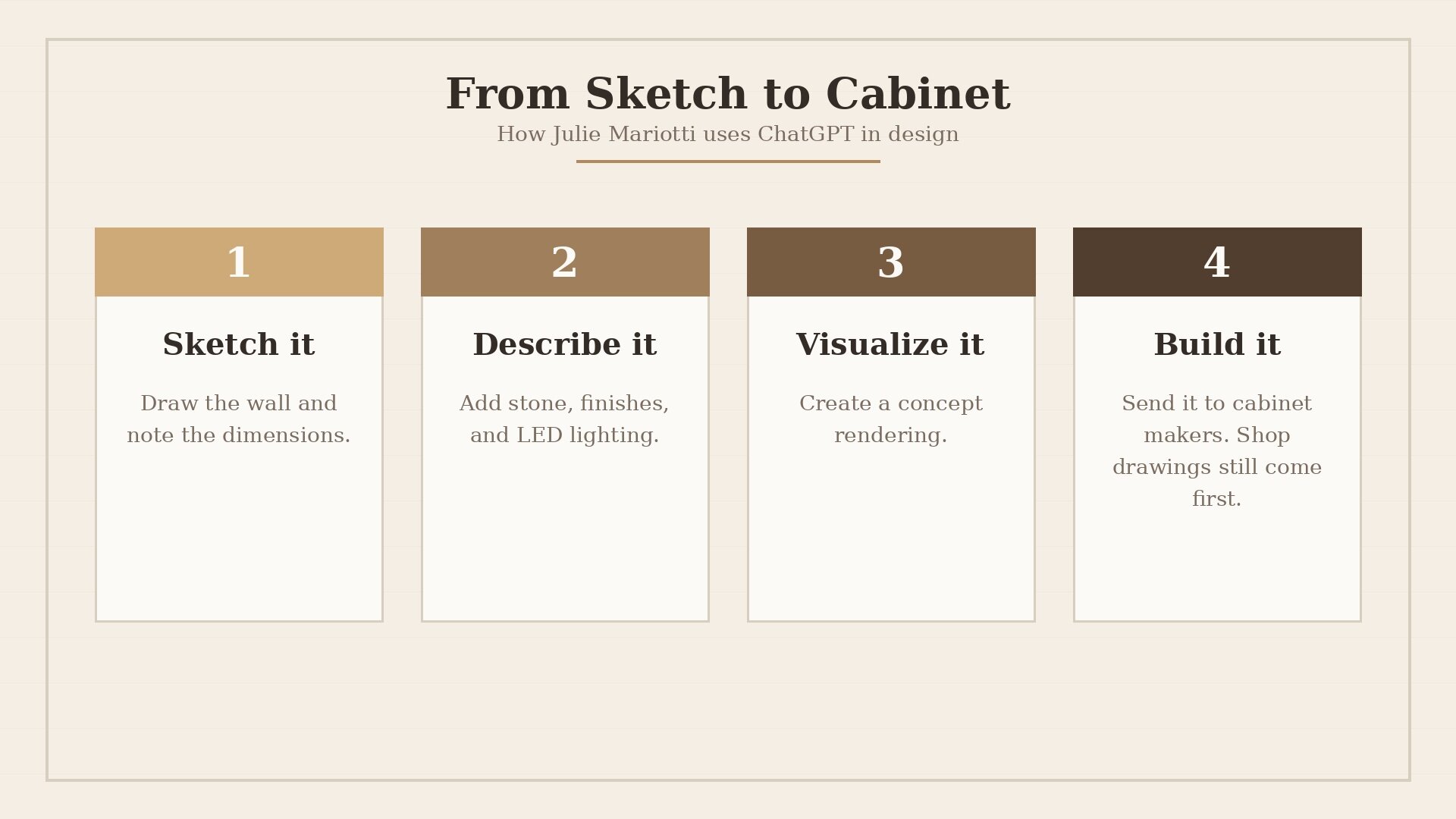
- Sketch the wall, such as a 12-foot bar wall, with dimensions.
- Describe the stone, finishes, and LED lighting.
- Generate a visual concept.
- Share it with her custom cabinet makers.
She stresses that the result does not replace a shop drawing. It helps her communicate her vision, and then her team builds it. She also finds materials, such as a natural fluted tile for a fireplace, from her favorite vendors.
Value Engineering: Where to Splurge and Where to Save
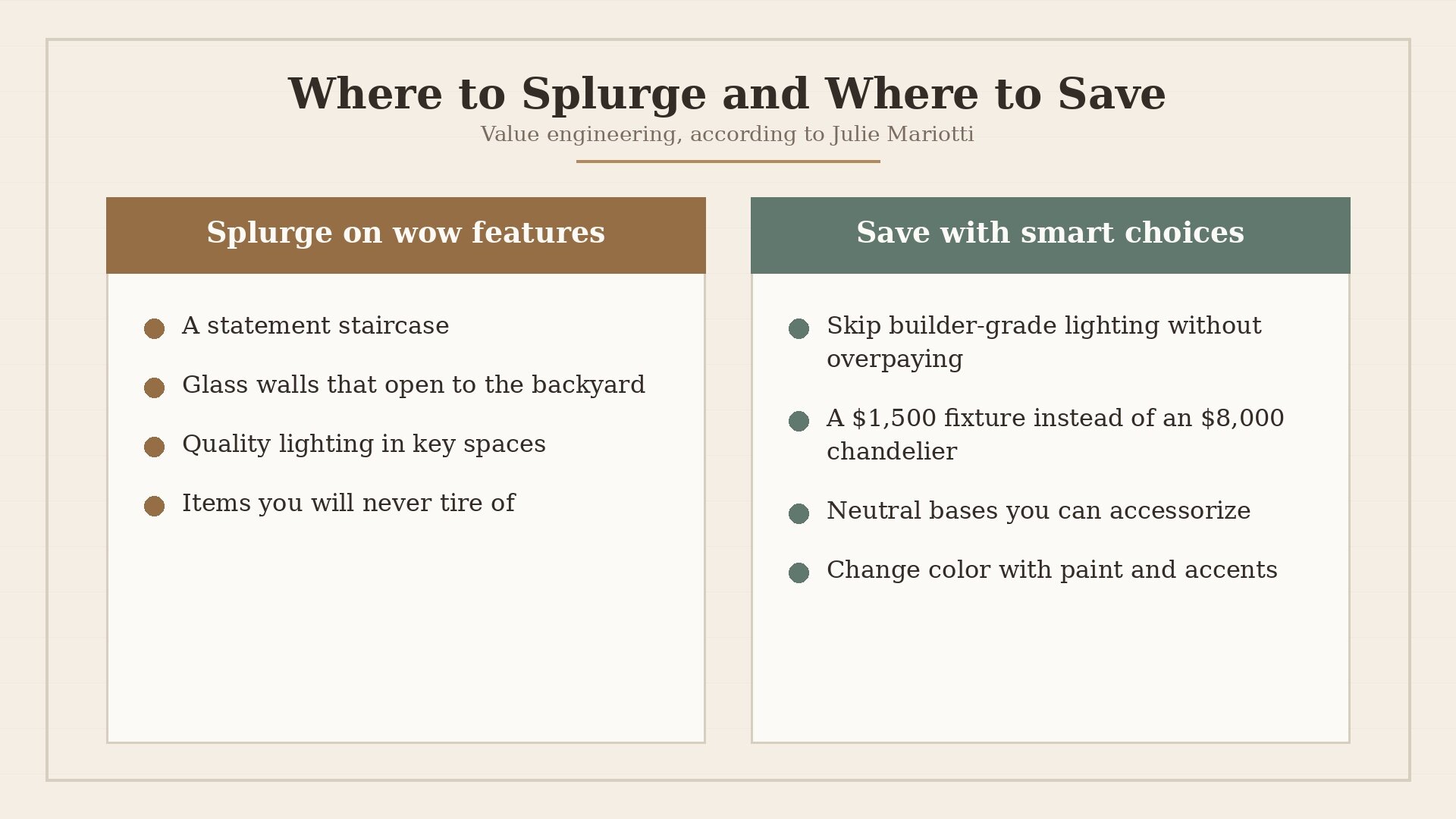
My husband and I are about to build, so I asked how to avoid missing details. Julie says not to rush, and not to fear value engineering. She spends a lot of time on it for clients. Lighting is one example. She dislikes builder-grade fixtures, but you do not need to overpay either. You can find a chandelier for $1,500 that looks great instead of paying $8,000.
She compares it to getting dressed.
“I always think it’s kind of like style, like when you dress yourself, there are certain pieces that it makes sense to invest in, like a really nice blazer, a good watch, an expensive belt. And then you can wear a Target t-shirt with a scoop neck, but you’ve got this awesome blazer on it and it makes your outfit. And I think houses, like we always try to do some wow features in a house. It’s really important to us to do that. So when you walk in, that’s where you put your money. You might have this amazing staircase and then maybe glass walls that open completely out to your backyard.”
She also likes a neutral base, since you can change accents and accessories as you grow. One client’s priority was an outdoor space with a fireplace, a screen, an outdoor kitchen, and sliding glass doors that open fully. They found ways to cut costs elsewhere.
Warm Contemporary Interior Design Trends
On the East Coast, Julie sees more contemporary homes, but the stark black and white look is fading. People want warmth. These warm contemporary interior design trends stood out:
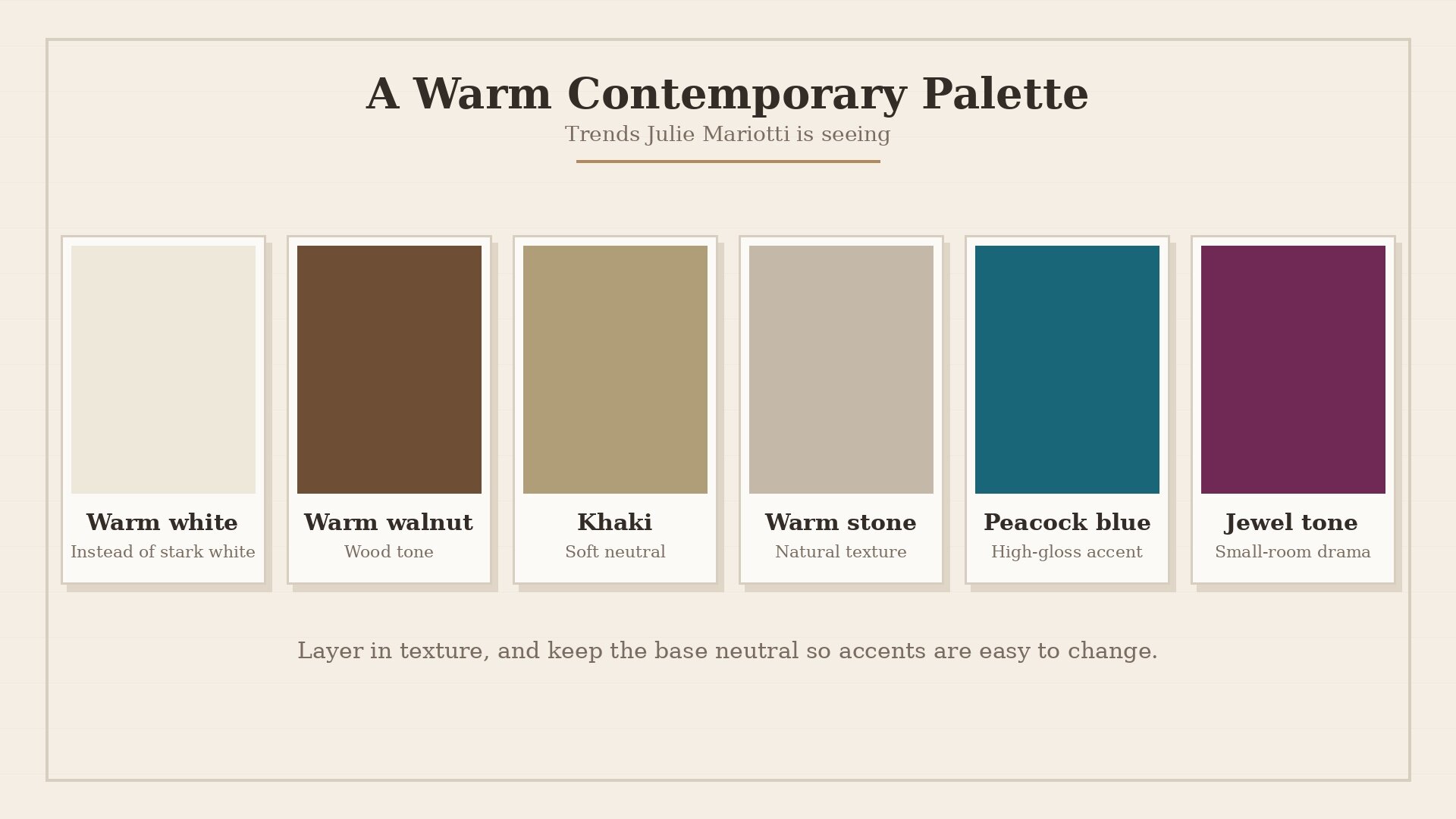
- Warm woods, like walnut, plus khaki tones and warmer stone.
- Warm white paint that can transform a dark house.
- Small rooms in dramatic colors, such as a study with peacock blue high-gloss cabinetry and jewel-tone lighting.
- Texture, because lack of it made the sterile look feel cold.
She finished a McLean spec home that began as black and white contemporary, then added warm woods and stone to soften it.
Refresh Instead of Moving
Many homeowners refinanced during COVID, Julie says, and they do not want to give up a low rate for a higher one. So they ask how to love their home again. Her fixes can be simple: new lighting, a new accent wall, fresh color, or a more inviting basement.
She also does larger projects. One favorite was a rambler on five waterfront acres on Maryland’s Eastern Shore. The pool sat at the water’s edge, and a tear-down would have meant losing it. Her team kept the house, raised the ceilings to 16 feet, and added a primary wing and an office.
When a Major Renovation Is Not Worth It
EV Custom Homes co-founder Julie Mariotti says her real estate background helps her be honest. Not every house justifies a big renovation. Some have eight-foot ceilings and narrow hallways that cannot be fixed.
“People think, well, if I throw a half a million dollars in this house, I could sell it for a million dollars more. And we want them to be able to do that. But a lot of houses, it’s just not going to happen. You’re not even going to recover the 500 that you put in there. So in that case, we push back, because we do know the market.”
For some homes, she has advised clients not to spend more than about $300,000. Two clients did spend around that amount, since they planned to stay another 20 years. Her advice is to consider structure, layout, neighborhood values, and renovation cost, and to be honest about your timeline.
Frequently Asked Questions About Custom Home Design and Renovation
How can ChatGPT help with interior design?
It can turn sketches, dimensions, and material ideas into visual concepts. These do not replace professional shop drawings.
Which luxury features are worth investing in?
Julie points to statement staircases, large glass doors, and quality lighting, and says other finishes can save money.
How do you know if a major renovation is worth it?
Consider structure, layout, neighborhood values, renovation costs, and resale value first.
What interior trends are gaining popularity?
Warm woods, natural stone, layered textures, and dramatic accent colors.
Connect With Julie Mariotti and Lisa Berg
Visit EV Custom Homes or find Julie on LinkedIn and Instagram. To follow my work, visit my website or find me on LinkedIn, Facebook, and Instagram. Thank you to Julie Mariotti of EV Custom Homes for such practical advice.
Apply to Be a Guest on the LUXEtalk Podcast
Luxury is about purpose, positivity, and smart decisions. If you work in luxury real estate, design, or construction and can help homeowners decide with confidence, I’d love to hear from you.