
I have hosted a lot of conversations on this show about luxury real estate, investment strategies, and building wealth through property. But every once in a while, someone sits down across from me and completely changes the way I see the market.
This was one of those conversations.
Seth Phillips of ADU Gold is the person most people in the California real estate industry call Mr. ADU. He is a founder, a broker with 38 years of experience, and someone who spotted a generational opportunity before almost anyone else did. What he shared with me on this episode is the kind of insight that takes most investors years to stumble onto on their own.
You can catch the full conversation right here on LUXEtalk:
Why I Had This Conversation
I talk about luxury real estate a lot on this show. But every so often, a guest comes in and completely reframes how I think about value creation, and this was one of those conversations.
Seth Phillips has been a licensed real estate agent and broker in California for 38 years. He is the founder of ADU Gold and the person most people in this industry call Mr. ADU. When someone with that kind of track record tells me there is a hidden opportunity hiding in plain sight, especially one rooted in a proven accessory dwelling unit investment strategy, I listen.
What makes Seth’s story compelling is not just what he built. It is how he got there, through a 2008 crash that cost him everything, a pivot into house flipping, a climb into $10 million luxury construction in Beverly Hills, and then a single car ride conversation that changed his entire direction. I wanted to bring that story, and everything he has learned since, to the LUXEtalk audience.
From the Courthouse Steps to Beverly Hills: The Career That Built Mr. ADU
Before Seth Phillips became the go-to expert on ADU development in California, he had to lose his job first.
In 2007, the market collapsed and Seth went from thriving real estate agent to unemployed overnight. Rather than wait it out, he pivoted into house flipping, buying foreclosed properties on the courthouse steps in Los Angeles for as low as $120,000 and selling them for $180,000. The margins were thin, but the education was invaluable.
From there, Seth scaled. He moved into higher-priced neighborhoods, eventually working his way up to ground-up luxury construction in Beverly Hills, Bel Air, and the Hollywood Hills, with homes selling for $10 million. Each step layered on new construction knowledge that would later become the foundation of everything he now offers as a service and his deep understanding of upzoning property value in California.
The turning point came during a car ride in Culver City. Seth and his business partner had just purchased a $635,000 probate property and paid an architect to design plans for demolition and a new build. Almost the exact day the plans were finished, his partner mentioned a new ADU law that had just gone into effect.
That was all Seth needed to hear. He immediately dove into research, and the more he studied it, the more convinced he became that ADUs had the power to change the lives of the forgotten middle-class homeowner and reshape the future of real estate entirely.
Seth scrapped the architect’s plans entirely. Instead of tearing the house down, they remodeled it beautifully and built the first two-story rooftop deck luxury ADU in Los Angeles in the backyard, navigating the ADU construction process in Los Angeles from the ground up with no existing roadmap to follow. They bought the property for $635,000 and sold it for $1,805,000.
After that sale, Seth held the house open every single weekend. But before each open house, he launched a meetup group called ADU Development, and a hundred people signed up in the first week. The response confirmed what he already suspected: community interest in ADUs as a housing option was already building, even before most people fully understood what they were. Over the course of that listing, roughly a thousand people came through the property.
He was not just selling a house. He was learning how people responded to the ADU concept so he could understand how to communicate its value as an accessory dwelling unit investment strategy to both buyers and sellers. By the time the property closed, he had left the spec building business entirely and gone full time into ADU construction services.
The ADU Laws That Changed Everything and Where They Stand Today
Most people have heard the term ADU but do not fully understand how dramatically California law has evolved to make accessory dwelling unit investment strategy one of the smartest plays available right now.
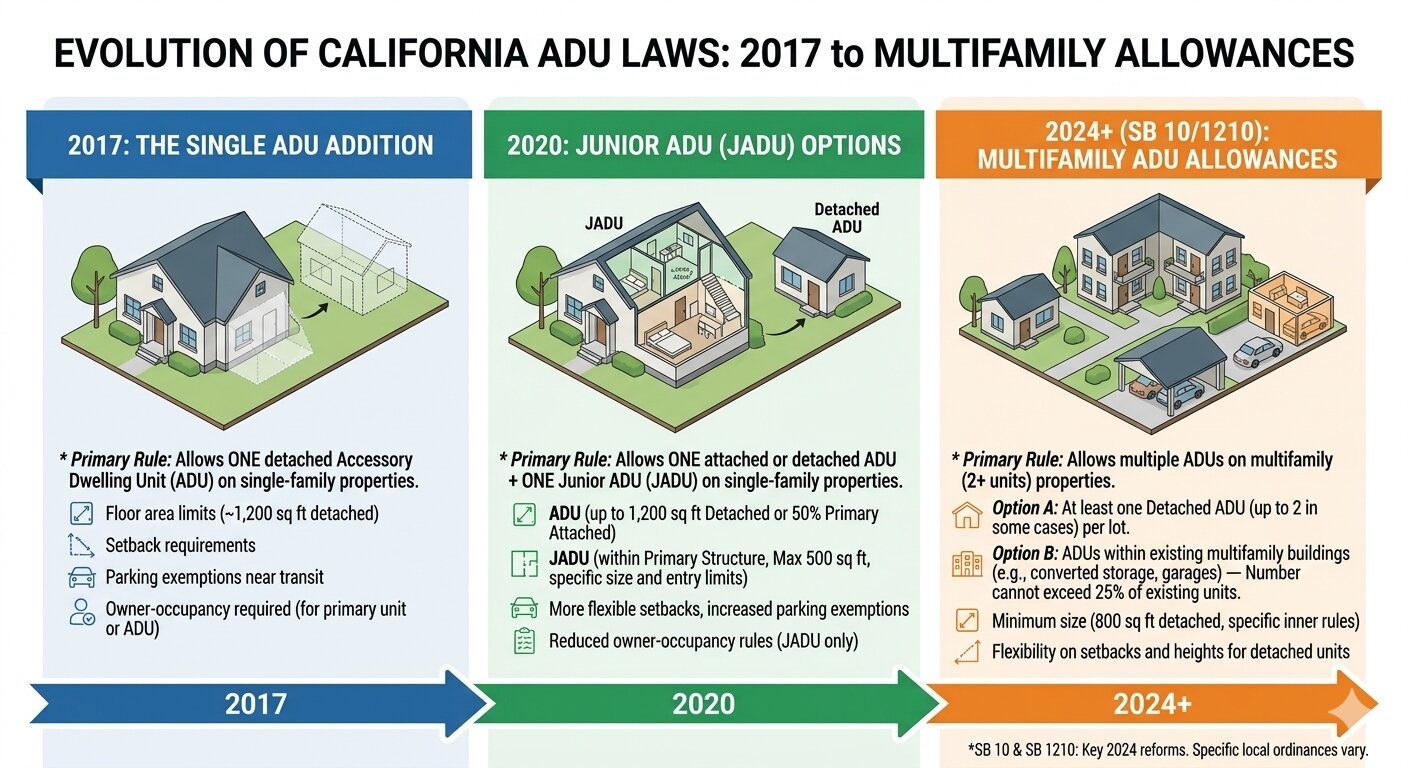
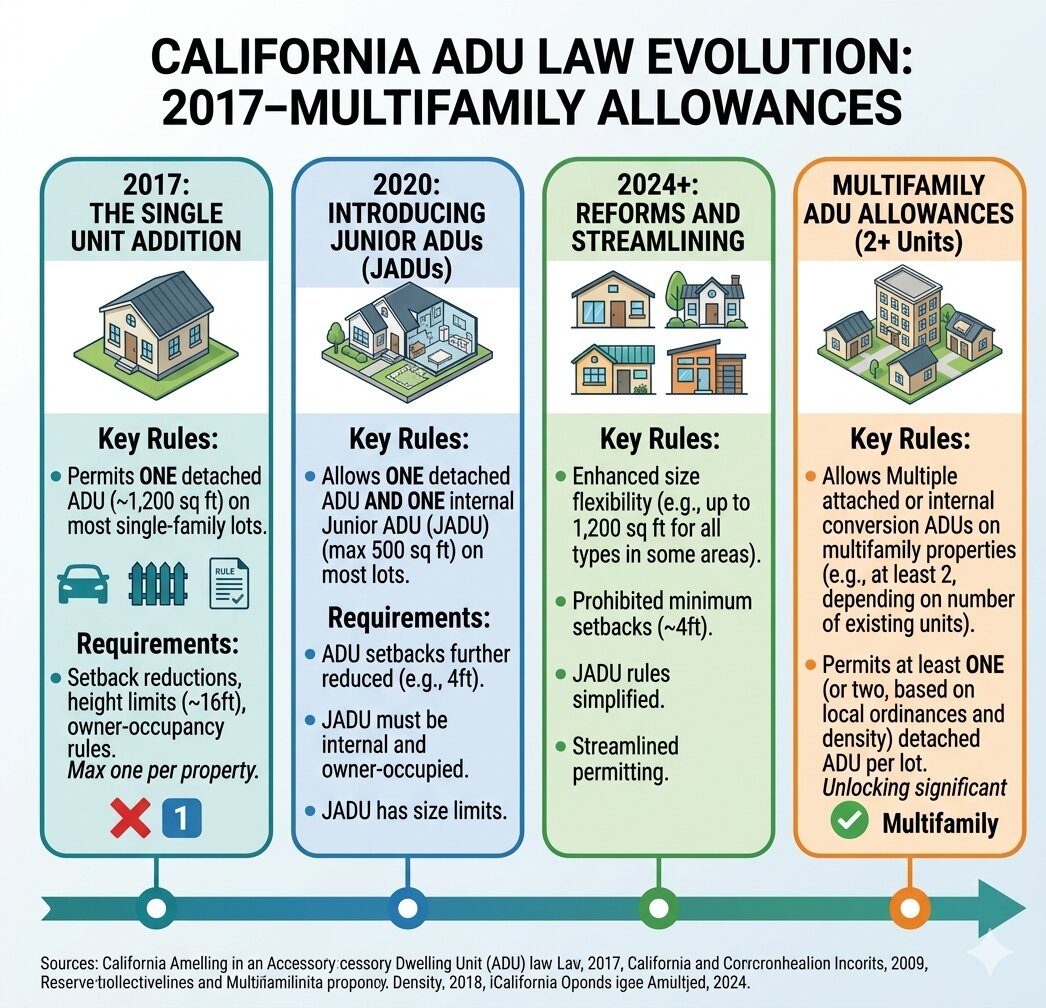
The first California ADU law went into effect in 2017. It broke from decades of single-family zoning tradition by allowing a second living unit on a single-family property. That alone was groundbreaking, but the state kept going.
The following year, California added the junior ADU, allowing a third unit on a single property. Then came the move that Seth says was the most important change of all: ADUs were extended to multifamily zoned properties. Owners who had previously maxed out their unit count under existing zoning could now add more.
Interestingly, Seth traced the origin of ADU legislation all the way back to Vancouver, Canada, where secondary units behind homes are called laneway houses. Portland, Oregon, picked it up next. But California was the first to implement it statewide, and if you want to understand the full scope of what you need to know about California’s new SB 9 housing law, the response to that statewide rollout was immediate and telling.
“Multifamily people pretty much all follow one of the most basic rules of real estate investing. Buy, don’t sell. They’ve got more equity, they pull equity out of a property, buy more stuff. You’re never selling stuff, but you’re using your existing assets, improving them, and pushing the ball forward. And now in this environment, they’ve got an opportunity to build a unit on free land. It’s free because you already own it.” — Seth Phillips, Founder of ADU Gold
For multifamily ADU Los Angeles owners specifically, this was a perfect fit. They are not looking at a backyard through the lens of where their kids play. They are looking at it as an asset, and building on land they already own with no acquisition cost changes every number in the investment analysis.
Seth put it simply: if you cannot make the math work when you are building on free land and only paying for construction, you are in the wrong place. Because that model works almost anywhere.
The Secret Value Proposition Nobody Is Talking About
This is the part of the conversation that stopped me in my tracks, because it is not obvious until someone lays it out clearly.
When California changed its ADU laws, it changed what you can build on a piece of land without changing the underlying zoning classification. That distinction is everything when it comes to upzoning property value in California. Multifamily-zoned land has always commanded a premium because you can put more units on it. These new laws let you put more units on land that is still priced like single-family land.
Seth explained the developer’s metric: price of land per door. How much am I paying per unit I can place on this property? With the new laws, that cost per door has been cut by a factor of 20 without any corresponding change in land price. The market simply has not caught up yet.
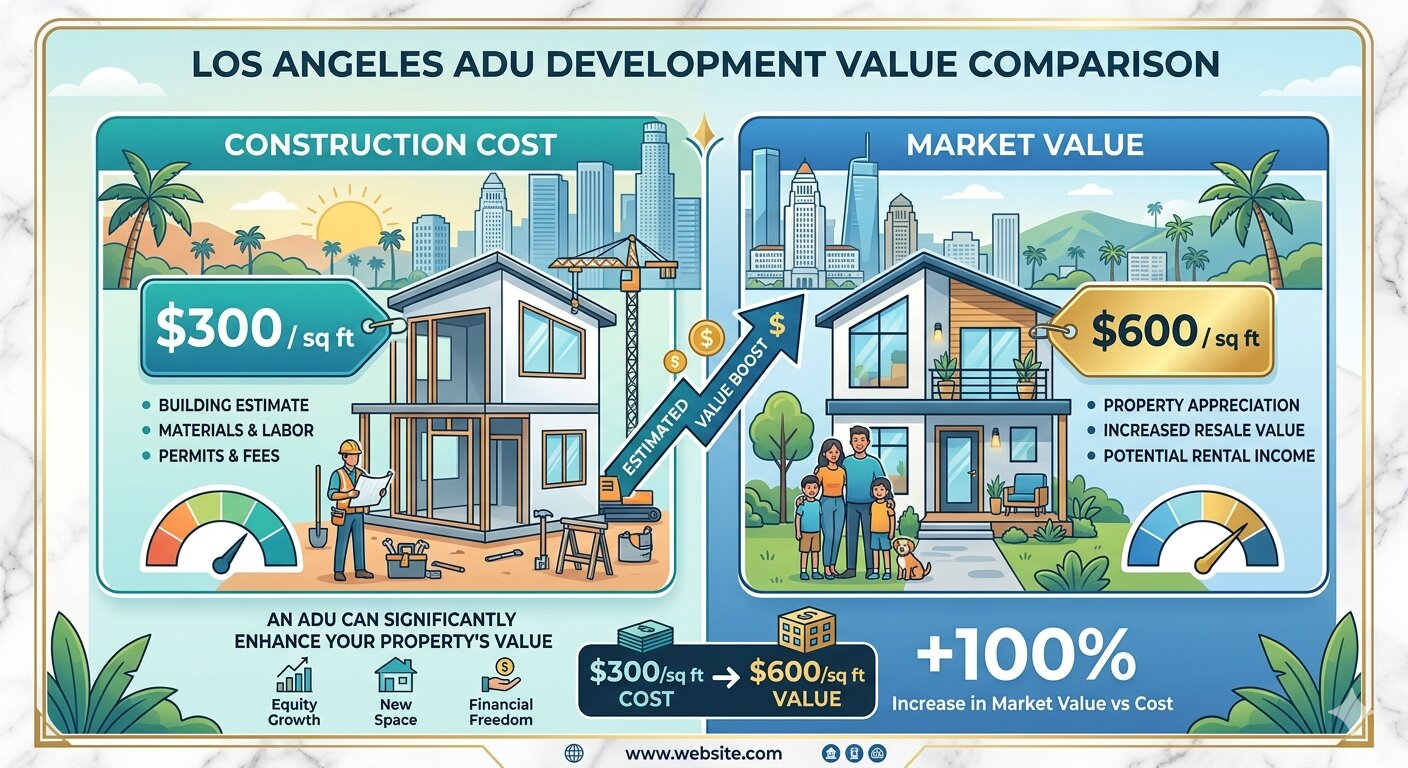
The practical play is buying a rundown, undervalued single-family property, tearing it down, and building multiple units on land that is still priced as if only one unit could go there. In Los Angeles specifically, where understanding the costs of building apartments makes the opportunity even clearer, the average retail price per square foot exceeds $600, and
“It costs you $300 a square foot to build it. The value it creates is $600 a square foot. You can’t go wrong with that investment. You just can’t.” — Seth Phillips, Founder of ADU Gold
That $300 to $600 spread is the core of the accessory dwelling unit investment strategy Seth has built his entire company around. It exists specifically because the ADU laws changed what land can produce without changing what the market is pricing it at.
Seth calls it the secret value proposition. And once you see it, it is genuinely hard to unsee.
What the ADU Process Actually Looks Like From Start to Finish
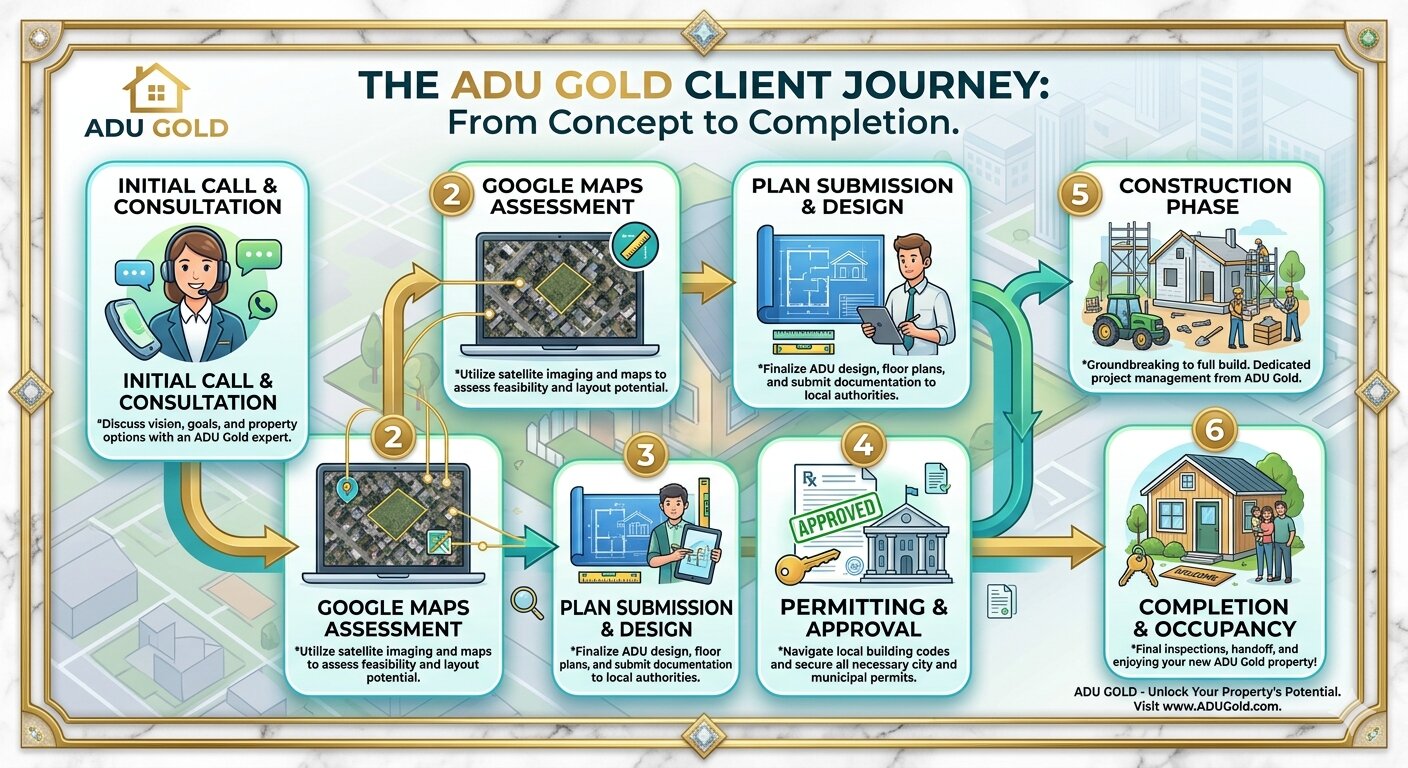
One of the most useful parts of our conversation was when Seth walked me through exactly what the ADU construction process in Los Angeles looks like from the moment someone picks up the phone. It is simpler than most people expect.
It starts with a call. Seth asks for the property address, pulls it up on Google Maps, and walks through the backyard virtually with the client in real time. In 20 minutes, he can assess usable space, spot trees and power lines that affect buildability, estimate sizing, and give a rough cost range. No site visit needed to get a meaningful first read on ADU feasibility.
If the client wants to move forward, the next step is hiring the contractor and beginning the architectural plan phase. The permitting process in California currently runs five to six months from plan submission, and construction adds more time on top of that. The realistic start-to-finish timeline Seth gives every client is approximately one year.
The inspection process in Los Angeles adds time at every stage of construction, and Seth acknowledged that this frustrates a lot of clients, himself included. But he was clear about why it exists: buildings that house people need to be built right, and what avenues the state ADU law provides does not leave room for shortcuts.
What I appreciated most about this part of the conversation was how honest Seth was about the timeline. There is nothing glamorous about a five-to-six-month permit window, but knowing the reality upfront is how you plan around it. Seth does not oversell the process. He just tells you what it actually is.
What Changed for Me After This Conversation
I came into this episode already appreciating what ADUs can do for property value. I left it thinking about the entire structure of the real estate market differently.
Seth made an observation near the end of our conversation that I have not stopped thinking about. He said the real estate market functions like a Ponzi scheme in one specific way: without new buyers entering at the bottom, nobody at the top gets to move up either. First-time buyers are the engine. And right now, the entry price is so high that fewer and fewer people can get in the door at all.
“The entry level of housing now is so high that the percentage of first-time buyers that can just get into the game is dropping further and further every day. Without new money coming in at the bottom level, nobody gets to move up the pyramid. If you stop the bottom level, it’s not going to be good.” — Seth Phillips, Founder of ADU Gold
What struck me is that Seth is not just identifying the problem. He is actively designing a product to solve it. California’s newest law allows a single lot to be subdivided into up to 10 separate parcels, each with its own APN that can be sold independently, and as the Urban Institute notes, this kind of zoning law reform is a crucial tool for expanding California’s housing stock. On multifamily versions, each parcel can carry two units, creating up to 20 legal living units on a single lot.
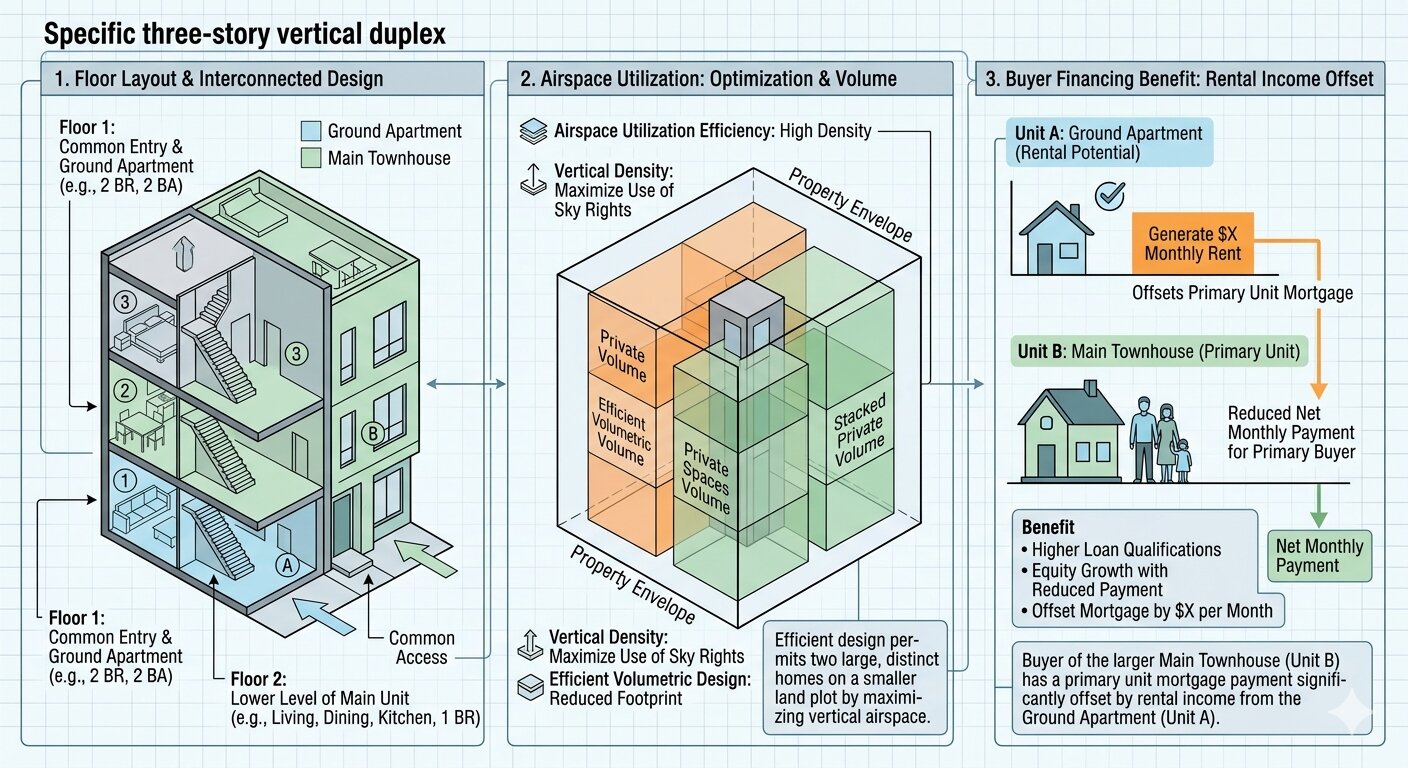
Seth has developed a three-story vertical duplex designed specifically to take advantage of this accessory dwelling unit investment strategy. The bottom floor houses a smaller unit, the two floors above form the primary living space, and the entire structure makes use of airspace on a standard-sized lot.
A buyer purchases the duplex, qualifies for the loan using projected rental income from the second unit, and immediately offsets their housing cost by renting that unit out.
It is one of the oldest house hacks in real estate, applied to a brand new product category that barely existed two years ago. As someone who covers luxury real estate for a living, this conversation reminded me that the most elegant solutions are sometimes the ones that make entry possible for the most people. Seth Phillips of ADU Gold is building those solutions, and I think the broader market is only just beginning to understand what that means.
Frequently Asked Questions
What is ADU Gold and what does Seth Phillips do? ADU Gold is a California-based firm specializing in ADU development in California, founded by Seth Phillips. Seth works with single-family homeowners, multifamily investors, and developers to assess ADU feasibility, manage the construction process, and maximize the value already sitting in existing properties.
Who is the best candidate for an ADU project? Multifamily ADU in Los Angeles owners are currently the clearest fit, since they approach the decision purely as an investment without the emotional layer of it being their home. Single-family homeowners can also benefit significantly, especially in high-value markets where the cost-to-value spread strongly supports building.
How long does the ADU construction process in Los Angeles take? Seth gives clients a realistic start-to-finish timeline of approximately one year. That covers architectural plan preparation, a permitting window that currently runs five to six months in California, and the construction period with mandatory city inspections at each phase.
How much does it cost to build an ADU in Los Angeles? Seth uses $300 per square foot as a working construction cost figure that covers most projects in California. In Los Angeles, where average market value exceeds $600 per square foot, that spread between cost and value is the core argument for the accessory dwelling unit investment strategy that ADU Gold is built around.
What is the newest opportunity in ADU development Seth is excited about? California’s latest law allows a lot to be subdivided into up to 10 separate parcels with independent APNs. On multifamily versions, each parcel can support two units, creating up to 20 legal living units on a single lot. Seth has designed a three-story vertical duplex to take advantage of this, helping first-time buyers qualify using rental income from the second unit to increase their purchasing power.
You Found Your People
If this episode spoke to you, there is a whole community of people thinking about the same things. Come find us and keep the conversation going.
Get in touch with Seth Phillips:
- Website: https://www.adugold.com/
- LinkedIn: https://www.linkedin.com/in/sethphillips3/
Connect with me (Lisa Berg):
- Website: https://lisabergrealestate.com/
- Youtube: https://www.youtube.com/@LisaBerg19
- Instagram: https://www.instagram.com/the.lisaberg/
Apply as a Guest on the LUXEtalk Podcast
Real estate is evolving fast. Whether you are building, investing, developing, or reimagining what luxury means in today’s market, the conversation belongs here.
If you are a real estate professional, investor, developer, or industry expert with a story worth telling and insights worth sharing, I would love to have you on the show. LUXEtalk exists for exactly these conversations.