
Every real estate decision starts the same way. A client feels the pull toward what is safe, and a quieter pull toward what actually fits their life.
That tension sits at the center of my conversation with Margie Warrell author of The Courage Gap, a leadership expert and bestselling author who has spent decades studying why people freeze at the exact moment they need to move.
On this episode of LUXEtalk, Margie and I talk about comparison, fear, and the kind of self-trust that changes how you show up, in real estate and everywhere else.
Curious about this conversation? Here’s a short preview from our discussion:
The Armed Robbery and Loss That Redefined Margie Warrell’s Life
I always ask my guests what shaped them before they became who they are now. With Margie, the answer was heavier than I expected. In her late twenties, she found herself in an armed robbery with a gun pointed at her head. Ten days later, nineteen weeks pregnant, she learned her baby had died.
Most people would understand if that broke someone. Margie chose something different. In the months that followed, she journaled, she prayed, and she made a decision that would shape the rest of her life. She would not define herself as a victim. Awful things happen to everyone at some point, she told me, but living from a victim mindset is a choice, and she chose not to make it.
Watch the full video here:
That decision sent her back to school for psychology, then coaching, then a PhD in human development. You can read more about her path from a dairy farm in rural Australia to advising Fortune 50 CEOs on her site. Researchers at Cambridge Judge Business School have found that leaders who openly name their fear and difficult emotions, rather than burying them, build more resilient teams than those who perform constant positivity. Margie’s own story backs that up. She did not skip the grief. She moved through it and let it point her toward a purpose.
That is really what this whole conversation comes down to. Not the absence of fear, but what you choose to do the moment it shows up.
Why Comparing Your Business to Everyone Else’s Is Costing You Peace
Margie and I spent a good chunk of the conversation on something every agent I know struggles with: comparison. She pointed out that most of us are addicted to our devices and the scroll, and that the scroll does not just numb us. It stokes insecurity. Not pretty enough. Not successful enough. Not selling enough.
I hear versions of this from agents constantly. Someone closes a big listing and posts about it, and suddenly everyone else in the office feels behind, even if their own year is going fine. Margie’s point was that this insecurity rarely has anything to do with reality. It has to do with measuring your worth by numbers that were never meant to define you: follower count, GCI, where you rank against the agent down the street.
If you’re weighing a big move in your own business, my buyer resources walk through decisions the same way Margie frames courage, one grounded step at a time rather than a reaction to what everyone else is doing. It’s a theme I keep coming back to on LUXEtalk, because the agents and business owners I talk to face this same trap in different clothes.

Margie’s answer to the comparison trap is not to pretend it does not exist. It’s to notice it and choose a different reference point.
The Real Reason High Achievers Never Feel Like Enough
This next part hit close to home for me, and I suspect it will for a lot of agents reading this. Margie has a name for the pattern she sees in her highest-performing clients: the insecure overachiever mindset. It’s the drive to prove something to someone who doubted you once, years ago, whether that was a teacher, a parent, or a kid who did not pick you for the team.
She put it better than I could:
“I often call them in my book The Courage Gap insecure overachievers, and often it’s an insecurity that drives us in some ways too. It’s like I want to make up and prove to anybody who said I was dumb in second grade, or didn’t pick me for the team, that I am someone. But when that is running the show, we’re really captive to that, and so it’s impossible to feel that sense of adequacy. It takes really stewarding our inner lives and being anchored in values that don’t change with headlines or the market, anchored in who it is you most want to be, regardless of whether or not you make the president’s club this year or whether or not you fill in some external metric. That’s how you become okay with yourself.”
I think about how many agents I know who are still chasing the approval of someone who is not even paying attention anymore. Production driven by proving something looks a lot like production driven by purpose from the outside, but they feel completely different from the inside. You can follow more of Margie’s reflections on this on Instagram, where she talks openly about the difference. A survey from the National Association of REALTORS found that housing market pressure is already straining people’s health and relationships. Layer an insecure overachiever mindset on top of that, and it is no wonder so many of us burn out chasing numbers instead of building something sustainable.
How Fear Hijacks Your Brain and What to Do About It
Here’s where the conversation got practical. Margie explained that anxiety almost always starts with a thought about an unwanted future. Your brain is not being dramatic on purpose. It is doing exactly what it evolved to do.
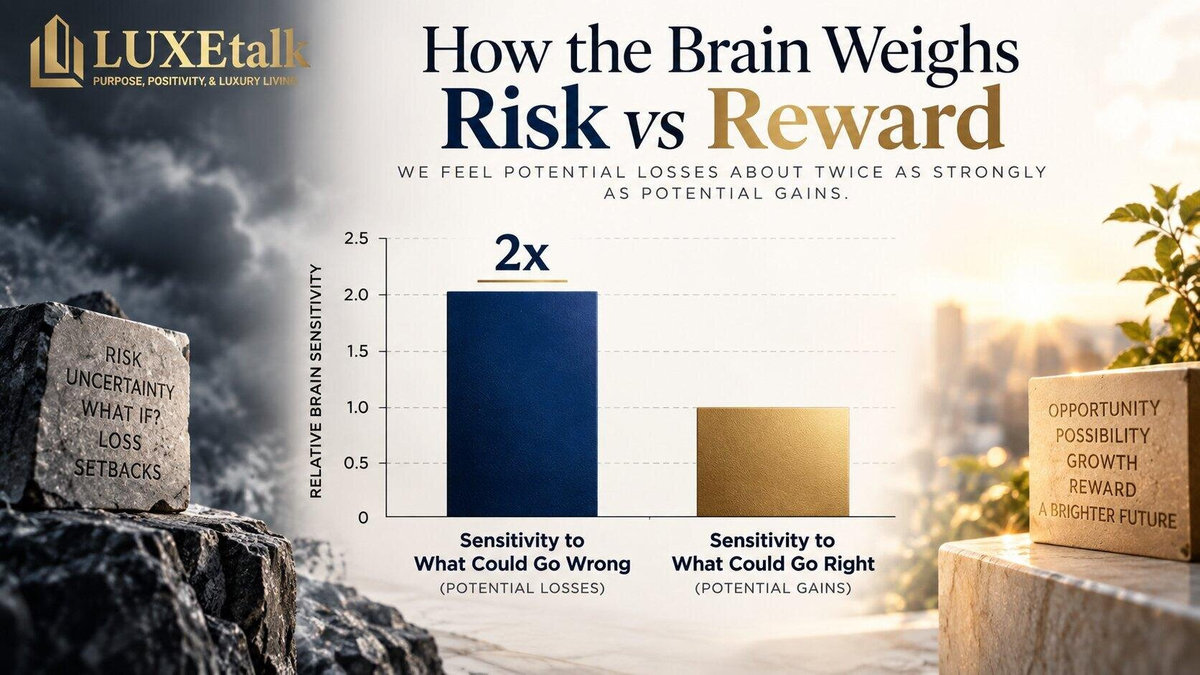
Our brains, she told me, are twice as sensitive to what could go wrong as they are to what could go right. That is not a flaw. It is wiring built for survival, and researchers studying courage in decision making have found the same imbalance shows up at the neural level.
A 2025 neuroimaging study published in Depression and Anxiety found that heightened threat-focused thinking correlates with reduced activity in the exact brain regions responsible for judgment and emotional control. In other words, the more we let fear lead, the harder it becomes to think clearly.

Margie’s fix is simpler than you would expect. Fear lives in the body before it fully registers in the mind, so the fastest way back to clear thinking is physical: one deep breath, sitting tall, coming back into the present moment. You can connect with her directly on LinkedIn, where she posts regularly on exactly this kind of practical, research-backed guidance.
I have started sharing pieces of it with my own clients when negotiations get tense, and it works the same way there as it does anywhere else. I also share a lot of this behind-the-scenes on my own Facebook page, because I think agents need permission to talk about the stress of this job out loud.
What Margie Warrell Learned Quarantined Alone in Singapore During COVID
Margie told me a story that stopped me for a second. In March 2020, her husband was hospitalized in Singapore with one of the earliest COVID cases. Their kids were living on another continent that had just closed its borders. She was placed into a fifteen-day quarantine, and everything happened at once.
“My fear was running off the reservation, imagining a million directions of negative future scenarios: what if, what if, what if. I had to just keep stopping and pausing and grounding myself in what I knew to be true, that I’m okay in this moment, I can meet what this moment needs, and who is it that I want to be for my kids, for my husband. I had to do that multiple times a day in those first few days, but that actually just gave me this presence. I think being grounded in a calm presence is the ultimate gift we have for ourselves, being grounded in faith and not fear, in self-trust and not self-doubt. Taking those few breaths can help us do that, and then go, okay, now what is the next best thing I need to do right now, and just focus on one small thing.”
She talks about this kind of grounded presence often on her Live Brave podcast, which you can find at margiewarrell.com. A recent industry survey on buyer decision-making found that emotion, not logic, drove more than a third of recent buyers to act against their own better judgment.
I see this constantly in my own market here in Whatcom County.
The client who panics during an inspection response window is not being irrational. Their nervous system is doing exactly what Margie described. Naming it out loud, the way she did during quarantine, is often the fastest way through it. You can see more of the local side of this work on my Instagram, where I post about what our market is actually doing week to week.
The One Question That Reveals Your Bravest Next Decision
By the end of our conversation, Margie brought it back to something simple enough to use today. Self-trust for real estate agents, and for anyone else navigating a hard call, does not come from having every answer. It comes from asking one honest question.
“The quality of your decisions shapes the quality of your life. Whatever decision you’re facing right now, there is going to be a part of you that is pushing you toward what feels safest in the moment, but that may be at the expense of what will make you more fulfilled over time. So just take a moment, get quiet, get still, put your hand on your belly or your heart, and ask what is the brave decision I need to make right now. It doesn’t mean it’s easy. It doesn’t mean it’s comfortable. It doesn’t mean there won’t be moments where you feel a little awkward or anxious. But deep within you is a wisdom that knows what it is you need to do, and if you keep tapping into that, it’s going to set you on a path you’ll never regret.”
That line has stuck with me since we recorded. I think about it every time a client hesitates on an offer, or every time I hesitate on a decision in my own business here in Lynden. Courage is not the absence of fear. It is choosing what will fulfill you over what merely feels safe.
If you want the full five-step framework behind this, Margie lays it out in her book, The Courage Gap, available through her site. If you’re weighing a sale of your own right now, my seller resources are built around the same idea: get quiet, get clear, then move.
You can also follow Margie’s ongoing work on Facebook if this conversation resonated with you.
Want to hear my entire conversation with Dr. Margie Warrell author of The Courage Gap about closing the gap, quieting comparison, and building self-trust? Listen to our podcast episode!
FAQ Section
What is The Courage Gap, and how does fear affect our decisions?
Dr. Margie Warrell explains that the courage gap is the space between what we know we should do and what we actually do when fear takes over. Closing that gap starts with letting values and purpose guide decisions instead of fear.
Why do insecure overachievers struggle with self-trust?
Early insecurities often shape how people see themselves well into adulthood. Margie Warrell explains why the drive to prove something to others can quietly undermine self-trust, even in high-performing agents.
Why does the brain focus on what could go wrong?
The brain is wired with a threat-detection system that is more sensitive to potential loss than potential gain. Margie Warrell shares how intentionally resetting focus toward what you want to create, rather than what you fear losing, opens space for better decisions.
Apply as a Guest on the LUXEtalk Podcast
Real estate is full of moments that test courage, from market shifts to client setbacks to the quiet fear of not measuring up. Margie’s conversation reminded me that courage is not a trait some agents have and others don’t. It’s a decision you make one moment at a time, whether you’re closing your first deal or advising Fortune 50 CEOs as she does.
If you have a story about facing fear, rebuilding trust in yourself, or making a brave decision that changed your business, I would love to have you on the show.